ATG Tickets - Theater Tickets
- 4.7
- Rating
- 100.00K
- Installs
- Free
- Price

 Analysis by App-foxy
Choosing a theater show often starts with a simple problem: I know I want an evening out, but I do not yet know which production, venue, or performance time makes sense. ATG Tickets is designed for that moment, bringing Broadway and US theater ticket discovery into a single events app from ATG Entertainment. I found its appeal less in the idea of “buying a ticket on a phone” and more in how it can shorten the distance between a vague plan and a specific show.
The app is free, aimed at everyone, and runs on Android devices using Android 10 or later. Its current release is version 1.1.5, and its 4.7 average from around 981 ratings suggests that many users find the experience dependable. With over 100K installs, it is not an obscure tool, although its usefulness naturally depends on whether the shows and locations you care about fit its theater coverage.
From “we should go out” to a show worth booking
My realistic starting point was a familiar one: two people want to see a musical, but neither wants to spend the evening jumping between venue pages, ticket sites, and search results. I would open the app with a broad idea rather than a fixed decision—perhaps a New York show, a musical, or a performance that fits a particular evening. That is the kind of uncertainty this app handles best.
You May Also Like

 Blood Strike: 2.5 Anniversary
Blood Strike’s Loadouts Turn Every Drop Into a Tactical Gamble
A close look at Blood Strike’s custom loadouts: how fast access to signature weapons reshapes its battle royale rhythm, rewards preparation, and narrows the gap between fights.

 Pandora - Music & Podcasts
Pandora’s Music Is Easy to Start, but Harder to Recover
Pandora’s strength is its low-effort path from a seed to a station. Its weak spot is how much confidence it asks you to place in connection, setup, and quiet recovery.

 8 Ball Pool
 Is Built on Rivalries, Rematches, and Routine
A close look at the rivalries, rematches, shared routines, and unanswered safety questions that turn a quick pool match into a persistent mobile community.

 Samsung Music
’s Quiet Strength Is Playing What You Already Own
Its reach comes less from spectacle than from dependable access to a personal library. That simplicity is both the app’s strongest retention engine and its ceiling.

 AccuWeather: Weather Radar
AccuWeather Review: A Quick, Clear Forecast for Everyday Decisions
For everyday plans, the best forecast is the one you can understand quickly. AccuWeather makes rain timing, radar, and local conditions easy to act on, with a few trade-offs.

 Hill Climb Racing
Why Hill Climb Racing Still Turns Crashes Into One More Run
A tiny car, a bumpy hill and one more upgrade: Hill Climb Racing keeps resurfacing because its simple chaos makes every near-miss feel personal.
More From Our News Desk



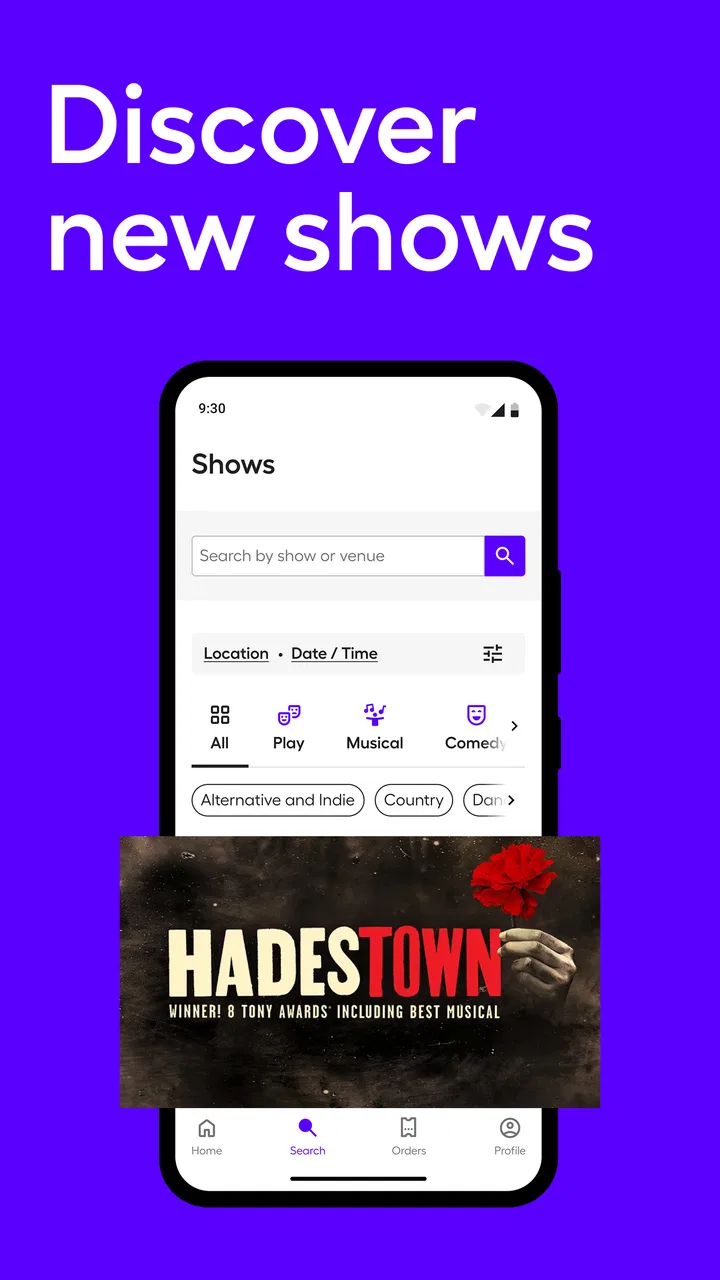
The first useful habit is to treat the app as a discovery tool before treating it as a checkout tool. If I already know the exact production and performance, a direct venue or ticketing route may be quicker. If I am comparing several possibilities, the app has more value because it gives the search a central starting point instead of forcing me to remember every theater’s own process.
That distinction matters. Theater booking is not like ordering a routine product. The decision includes the production itself, the venue, the date, the start time, the seating arrangement, and the practical journey home. A good ticket app cannot make those choices for me, but it can make the comparison stage less scattered. I found that the best results came from deciding my non-negotiables first: the day, the latest acceptable finish, and whether I preferred a musical or another kind of stage show.
Searching with a plan instead of browsing endlessly
Once I had a rough brief, I could use the app’s focus on Broadway and US theater tickets to narrow the outing. This is more useful than entering a show title immediately when the group has not agreed on what to see. It also suits visitors who are building an itinerary and want theater to sit alongside dinner, sightseeing, or another evening activity.
A practical approach is to compare performances in this order: first the show, then the date, then the time, and only after that the seats. Many people do the reverse and become attached to a convenient-looking performance before checking whether the production is actually right for the group. In my experience, starting with the event prevents an attractive time slot from driving the entire decision.
The app’s free price also makes it easy to keep available while planning without committing money simply to explore. That does not mean every final cost will feel simple, because ticket purchases can involve the normal details of a theater transaction. I would still inspect the final booking summary carefully before confirming, especially when comparing performances that look similar at first glance.
Checking the details that affect the whole evening
Once a candidate show appears, the real work begins. I would check the performance date and start time, then consider how the venue fits the rest of the evening. A late show may be ideal for one group and inconvenient for another. A matinee may work better for families or travelers with an early morning ahead. The app helps me reach the event choice, but I still need to think like a person attending a live performance rather than a shopper selecting an item.
This is also where I would pause before handing the plan to someone else. If I am booking for friends, I would share the show name, venue, date, and time before moving to payment. That small handoff avoids a common mistake: one person assumes “the theater show” means one performance while another has been looking at a different day. A ticket app can speed up the transaction, but it cannot repair an unclear group decision.
For visitors to New York, the event information should be considered alongside transport and neighborhood plans. I would not place a performance at the end of a tightly packed itinerary without leaving room for delays. The app is useful for finding the ticket, but the safest workflow is to use it as one part of the evening plan, not as a replacement for checking how the evening connects together.
How the booking handoff feels in everyday use
The most important handoff is from browsing to booking. At that point, the person who explored the options may not be the person whose payment details or schedule determine the final choice. I would send the essential details to the group before proceeding, rather than relying on a screenshot with only a poster and a vague title. The exact performance matters more than the promotional image.
A second handoff happens between the app and the venue experience. The app can help me select the event, but the theater is where the plan becomes real: arrival time, entry, seating, and the behavior expected during a live performance. I would keep the booking confirmation easy to find and avoid leaving it buried in a long message thread. That is not a criticism unique to this app; it is simply a sensible habit whenever a mobile booking becomes the gateway to an in-person event.
The third handoff is between the buyer and the rest of the party. If I am purchasing several tickets, I would confirm who is attending before completing the order and make sure everyone understands the performance time. This is a particularly useful workflow for family trips, birthdays, and workplace outings, where one person often becomes the unofficial organizer. The app reduces the number of places that organizer needs to search, but it does not remove the need for a clear final message.
I also like the idea of separating discovery from commitment. I can use the app to explore possibilities when the group is undecided, then return once the choice is agreed. That is less stressful than trying to negotiate show, date, and seats while a checkout screen is waiting. It also makes the app more useful for spontaneous planning: I can investigate an evening option first and only proceed when the timing works for everyone.
Where it is stronger than the usual alternatives
The usual alternative is to search the web, open several theater pages, compare ticket routes, and keep switching between tabs. That approach can be perfectly reasonable when I already know the venue, but it becomes tiring when I am starting with a broad question such as “What should we see in New York?” A dedicated events app gives that search a more focused home.
Another alternative is a general ticket marketplace. Those services may be helpful when I am comparing many kinds of events, including concerts and sports, but that breadth can also make theater discovery feel less direct. ATG Tickets is more relevant when the outing is specifically about Broadway, US theater, or musicals. I would choose the app when theater is the center of the plan, and a broader marketplace when I am comparing theater with unrelated event types.
There is also the direct venue route. Going straight to a theater can be better when I need venue-specific information or have a very precise question about one production. The app is more convenient at the beginning of the journey, while a venue’s own information may become more important as the date approaches. In other words, I see this app as a strong front door to the booking process, not necessarily the only source I would consult for every practical detail.
That trade-off is easy to miss. Convenience comes from concentration: the app keeps the theater search focused. The cost of that focus is that it may not be the ideal tool for someone who wants a complete, all-purpose event marketplace or who has already settled on a venue and simply wants its own booking environment.
A useful workflow for families and groups
For a family, I would begin by agreeing on the acceptable performance window before opening the app. Children, older relatives, and people traveling from outside the city may have very different limits. I would then use the app to find a show that fits that window, check the event details together, and only afterward discuss seating and payment.
For friends, the most efficient method is to nominate one person as the searcher and one as the final approver. The searcher can shortlist a few suitable performances, while the approver checks the date and time against the group’s plans. That division prevents five people from independently searching and returning with five slightly different options. It is a small but genuinely useful advantage of having a focused theater app in the middle of the conversation.
For a traveler, I would search before committing to a day’s itinerary. Theater has a fixed start time, so it should anchor the evening rather than be added as an afterthought. I would leave a buffer for the journey, avoid placing a distant dinner reservation immediately before the show, and make sure the group knows which performance was booked. The app helps with the first decision; good scheduling protects the result.
What the result looks like when everything goes well
The successful outcome is not merely a ticket confirmation. It is a plan that everyone understands: the right production, the right performance, a realistic route to the venue, and a shared expectation of the evening. ATG Tickets contributes most at the point where scattered interest becomes a concrete event choice.
I found the app most satisfying when I used it early enough to compare options calmly. It is less impressive as a last-second rescue tool when the group is already outside, unsure of the venue, and trying to make an immediate decision. That is not because the app lacks value; it is because live theater leaves little room for confusion once the curtain time is close.
The app’s rating and growing install base make it easy to take seriously, but those figures should not replace personal fit. A theater fan looking for Broadway or US musical tickets has a clear reason to try it. Someone searching for every possible kind of entertainment may find a general event service more suitable. The category focus is the feature, and also the boundary.
Where the flow can break down
The first possible break is coverage. If the show, city, or venue I want is outside the app’s theater focus, the centralized search loses its advantage. In that situation, I would move to the relevant venue or another ticket service rather than forcing the app to solve a problem it was not built around.
The second break is decision overload within the group. An app can present options, but too many people can still create hesitation. I would avoid sending a dozen possibilities and instead share a short list with a clear recommendation. This is one of the less obvious lessons from using a booking app: better organization on the user’s side often improves the experience more than endless browsing.
The third break is the gap between discovering a performance and understanding the practical evening. A convenient start time may clash with travel, dinner, accessibility needs, or the energy level of the audience. I would treat the event selection as a checkpoint, not the end of planning. Before paying, I would make sure the group can actually reach the venue comfortably and stay for the full performance.
The fourth break is relying on memory after booking. Theater plans are easy to misremember, especially when several dates were discussed. I would save the confirmation in an accessible place and repeat the exact show and performance time to everyone attending. This simple handoff is more valuable than it sounds because it protects against the most avoidable kind of booking error: people arriving with different assumptions.
There is also a broader limitation for experienced theatergoers. If I already know the production, venue, seating preference, and exact performance, I may prefer a direct route that takes me straight to that event. The app’s discovery value matters less in that case. I would recommend it most strongly to people comparing options, planning a city visit, or organizing a group—not necessarily to someone who has already made every decision.
Who should download it, and who should look elsewhere
I would recommend ATG Tickets to a person who wants a focused way to explore Broadway and US theater tickets, especially when the show choice is still open. It is also a sensible companion for a New York trip, a musical-focused evening, or a group outing where one organizer needs a clear place to begin. Being free removes an obvious barrier to trying it during the planning stage.
I would be more cautious about recommending it as the only event app for someone whose interests change constantly between theater, concerts, sports, festivals, and local activities. A broader service may offer a more complete overview for that person. I would also point a highly venue-specific shopper toward the venue’s own channel when the main need is detailed information about one theater rather than discovery across shows.
The everyone age rating makes it approachable as an app, but the suitability of a particular performance is a separate question. Parents should still choose a production and time that fit their children, while adults arranging a group should consider the needs of the actual audience. A general age rating for the app does not make every theater outing equally appropriate for every attendee.
My final take after following the full journey
ATG Tickets works best as a focused bridge between an uncertain theater idea and a bookable performance. I like it because it gives the search a clear direction without charging to explore, and because its purpose is immediately understandable: find theater tickets, compare the evening, and move toward a live show. The experience becomes especially practical when one person is coordinating several others.
Its limitations are equally clear. It cannot decide which production suits the group, replace sensible travel planning, or guarantee that a theater-focused catalog is enough for every kind of event search. The handoffs still matter: from browsing to group approval, from booking to confirmation, and from the app to the venue itself.
For me, the right recommendation is straightforward: use ATG Tickets when theater is the main event and you need help turning a broad idea into a specific performance. Start with your date and audience, shortlist rather than endlessly browse, verify the final details before paying, and share the exact booking information afterward. Used that way, this free events app from ATG Entertainment feels like a practical planning companion rather than just another place to tap “buy.”
FAQs for ATG Tickets - Theater Tickets
01What is ATG Tickets and what does it offer?
ATG Tickets is a comprehensive app for purchasing theater tickets, offering access to a wide range of performances across numerous venues. Users can browse upcoming shows, view seating arrangements, and secure their tickets directly through the app, ensuring a convenient and seamless booking experience.
02Is ATG Tickets available for both Android and iOS devices?
Yes, ATG Tickets is available for download on both Android and iOS platforms. This ensures that users can access the app's features regardless of their device, making it easy to browse and purchase tickets from anywhere using a smartphone or tablet.
03How does ATG Tickets handle refunds and cancellations?
Refunds and cancellations are subject to the terms and conditions outlined by ATG Tickets. Generally, refunds depend on the specific event's policy. Users are encouraged to read the refund policy carefully before purchasing tickets to understand their options in case of a cancellation or change in plans.
04Are there additional fees when purchasing tickets through ATG Tickets?
Yes, purchasing tickets through ATG Tickets may involve additional service fees. These fees cover the convenience of booking online and vary depending on the event and seating choice. It's advisable to review the total cost, including any fees, at checkout before finalizing the purchase.
05How secure is the ATG Tickets app for transactions?
The ATG Tickets app employs secure encryption technology to safeguard users' personal and financial information during transactions. This ensures that all data shared within the app is protected, providing users with peace of mind while purchasing tickets through their mobile devices.
Pros
- User-friendly interface for easy browsing.
- Wide selection of theater events available.
- Secure payment options for peace of mind.
- Personalized recommendations enhance experience.
- Mobile ticketing for convenient access.
Cons
- Limited refund options can be restrictive.
- Occasional app crashes can be frustrating.
- Some users report slow loading times.
- Notifications can be overwhelming for some.
- Not all theaters support mobile tickets.

ATG Tickets - Theater Tickets
Gallery